How Rhialto turns literature by Shakespeare, Poe, Dickinson, Carroll and Robert W. Service into new gothic, dark-country and experimental music.
Some of Rhialto’s most useful source material was written long before Rhialto existed.
Literature can provide a character, conflict, image or unanswered question that is already rich enough to support a new piece of music. The goal is not to turn a poem or play into a lesson. The source is the starting point; the finished music still has to become its own work.
Rhialto has used public-domain writing by Shakespeare, Edgar Allan Poe, Emily Dickinson, Lewis Carroll and Robert W. Service in very different ways. This guide collects several examples and links to the detailed Behind the Song notes for the source research and creative decisions behind each one.
Shakespeare is particularly useful because a single scene can contain enough tension for an entire piece of music.
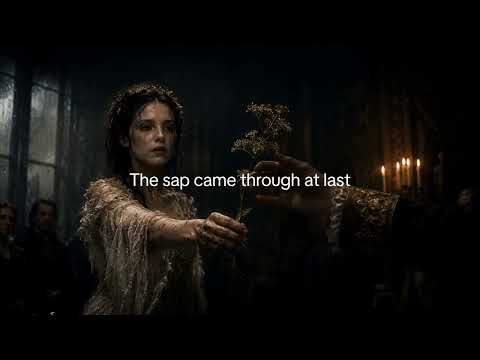
The Flowers She Named, performed by Vesper Mourdant, starts with Ophelia’s flower-distribution scene in Hamlet. Instead of simply retelling her story, the music asks whether the flowers can be heard as deliberate accusations. That idea led to a fractured gothic waltz in which the language and arrangement gradually lose stability.
Cordelia Said Nothing narrows King Lear to a different kind of refusal. Cordelia will not perform affection on command. Her “Nothing, my lord” becomes the centre of a gothic darkwave piece about truth, silence and the danger of refusing to say what power wants to hear.
Every Room Awake moves into Macbeth, using guilt and sleeplessness to turn an ordinary house into something that seems aware of what happened inside it.
The Statue Breathes begins with Hermione’s return in The Winter’s Tale, then asks a question the spectacle itself can obscure: if someone returns after years of loss, is forgiveness automatic?
The Emperor Worm grows from Poe’s The Conqueror Worm, with its image of human life as a doomed theatrical performance.
The Rhialto version pushes the metaphor one step further. If the worm always receives the final scene, perhaps it is not merely the conqueror. Perhaps it owned the theatre from the beginning.
That shift turns a literary image into a complete gothic-rock setting: ruined opera house, funeral-cabaret scale, orchestral weight and a final performer that does not need to fight for the stage because time has already given it the building.
Because I Couldn’t Stop draws on Emily Dickinson’s famous carriage ride with Death.
The useful feature of the poem is its restraint. Death is courteous. The journey is calm. That politeness makes the idea more unsettling, not less. The musical interpretation keeps that controlled surface while allowing the darkness beneath it to become increasingly difficult to ignore.
It is an example of adaptation through contrast: the source does not need to shout for the music to become gothic.
Sometimes the smallest unexplained detail creates the most room for invention.
In Jabberwocky, Lewis Carroll gives us the phrase “vorpal blade” but very little explanation of what such a weapon is. The Vorpal Forge treats that absence as creative space.
Rather than merely writing about the famous battle, Brillira’s version imagines the cultural process that could create such a weapon: a community forging it through labour, memory, sacrifice and shared purpose. A two-word object becomes a piece of worldbuilding.
Lou Took the Gold comes from Robert W. Service’s Yukon ballad The Shooting of Dan McGrew.
Instead of competing with the poem’s armed men, the Rhialto version changes the camera angle. The interesting figure becomes Lou: the person still standing after the violence and whose future is less fixed than theirs.
That shift lets Lux Arden turn a familiar literary source into dark country rather than simply singing a condensed version of the original narrative.
The attraction is not nostalgia. It is creative room.
A source can provide a character, symbol, setting or conflict. The new work can then change perspective, genre, narrator, scale or emotional emphasis. The strongest Rhialto pieces usually begin with one specific question rather than an attempt to preserve everything in the original.
Those questions create a bridge between something old enough to be familiar and something new enough to justify another piece of music.
The Behind the Song section also covers folklore and myth, real historical events, traditional music, visual art and original concepts. Each note separates the source material from the Rhialto interpretation and links to the finished music where available.
You can also browse Gothic Music, Dark Country or the complete Rhialto Music Library.
Follow the idea into the wider catalogue.
Occasional notes when new music, stories, art or behind-the-scenes work is worth sharing. No daily clutter.
Comments are reviewed by Rhialto. Share a thought about the post; your email is optional and will not be displayed.